
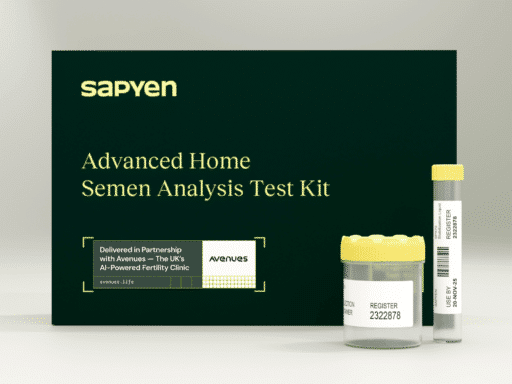


A significant shift is emerging in the early stages of fertility care in the United Kingdom. A leading fertility provider has introduced a new approach that allows both partners in a couple to complete essential fertility tests at home before attending their initial consultation.
Avenues Clinic has entered an exclusive partnership with Sapyen to integrate at-home fertility testing into its patient pathway. The arrangement includes home-based semen analysis for men and Anti-Müllerian Hormone (AMH) testing for women.
Through Avenues’ Reproductive Intelligence Review, couples are now able to carry out baseline fertility assessments from their own homes. As a result, they can attend their first clinic consultation with important diagnostic information already available.
For many individuals who travel from different parts of the UK to receive treatment at Avenues — particularly those seeking Fair IVF or services at clinics that do not enforce strict BMI requirements — the model reduces the number of preliminary clinic visits required before treatment planning begins.
The initiative addresses a long-standing imbalance in fertility medicine. While male-related factors are involved in around half of infertility cases, diagnostic testing has traditionally been centred on women and often conducted only within clinical settings.
Men are often tested later in the process, if they are tested at all, and frequently face tight deadlines for providing samples at clinics. This system can lead to delays, repeated appointments and treatment decisions being made without complete clinical data.
With the new model at Avenues, both partners carry out baseline tests at home from the outset. This adjustment shortens the time needed to obtain clinical insights, eliminating weeks of logistical delays and allowing the first clinic visit to focus on planning treatment rather than gathering information.
“The fertility journey shouldn’t start with waiting rooms and logistics,” said Dr Cristina Hickman, CEO of Avenues Clinic. “It should start with understanding. Our Reproductive Intelligence Review allows couples to complete essential diagnostics from home so that when they arrive, the conversation focuses on decisions rather than discovery.”
Sapyen’s technology supports this process through a patent-pending sperm stabilisation method that keeps semen samples viable for up to 72 hours after collection. This enables accurate laboratory testing without the need for immediate delivery to a clinic.
“Fertility outcomes suffer when the system delays information,” said Ash Ramachandran, CEO of Sapyen. “The question should never be why couples waited months to understand half the equation. Start with data. Reduce uncertainty early. Everything downstream improves.”
Medical specialists at Avenues say the change is expected to transform early consultations, with patients arriving already equipped with baseline results. This enables clearer discussions, earlier treatment planning and fewer exploratory appointments.
More broadly, the model positions fertility as a shared clinical issue from the very beginning. Male fertility assessment becomes part of the initial process rather than a secondary step introduced later.
For patients, the benefits include fewer delays, fewer clinic visits and a care journey that begins with reliable diagnostic information. For the healthcare system, the approach frees valuable clinical time that would otherwise be spent managing logistical steps.
In many ways, the redesign of fertility care is happening quietly — but at the stage that matters most: the beginning.