

PhysioPod® UK Limited has released the results of an independent service evaluation to coincide with World Lymphoedema Day 2026. The report, titled “Phase 1 Analysis: UK Treatments & Experiences of Head and Neck Lymphoedema (HNL),” examines current treatment practices and patient experiences.
This year’s initiative moves beyond raising awareness to highlight the specific challenges faced by survivors of Head and Neck Cancer who develop secondary lymphoedema, a condition that often remains under-recognised.
The evaluation was carried out between October and December 2025 and provides what researchers describe as a “real-world snapshot” of the current treatment landscape. A total of 84 respondents participated, including NHS clinicians (50%), private practitioners (31%) and patients (19%).
Findings from the evaluation indicate that the established “Core 4” care model – Manual Lymphatic Drainage, Compression, Skin Care and Exercise – has expanded in practice to what researchers describe as a “Core 6” approach. Clinicians are increasingly incorporating additional treatment methods to address the complex needs of HNL patients.
Survey results showed that 90% of practitioners now use Kinesio Taping while 75% include Scar Therapy in treatment plans. These techniques appear to have become widely adopted alongside the original four core therapies.
The evaluation also observed that specialist centres are increasingly introducing Photobiomodulation (Laser) and Negative Pressure Therapy, such as LymphaTouch, to assist in managing severe scarring and trismus (lockjaw).
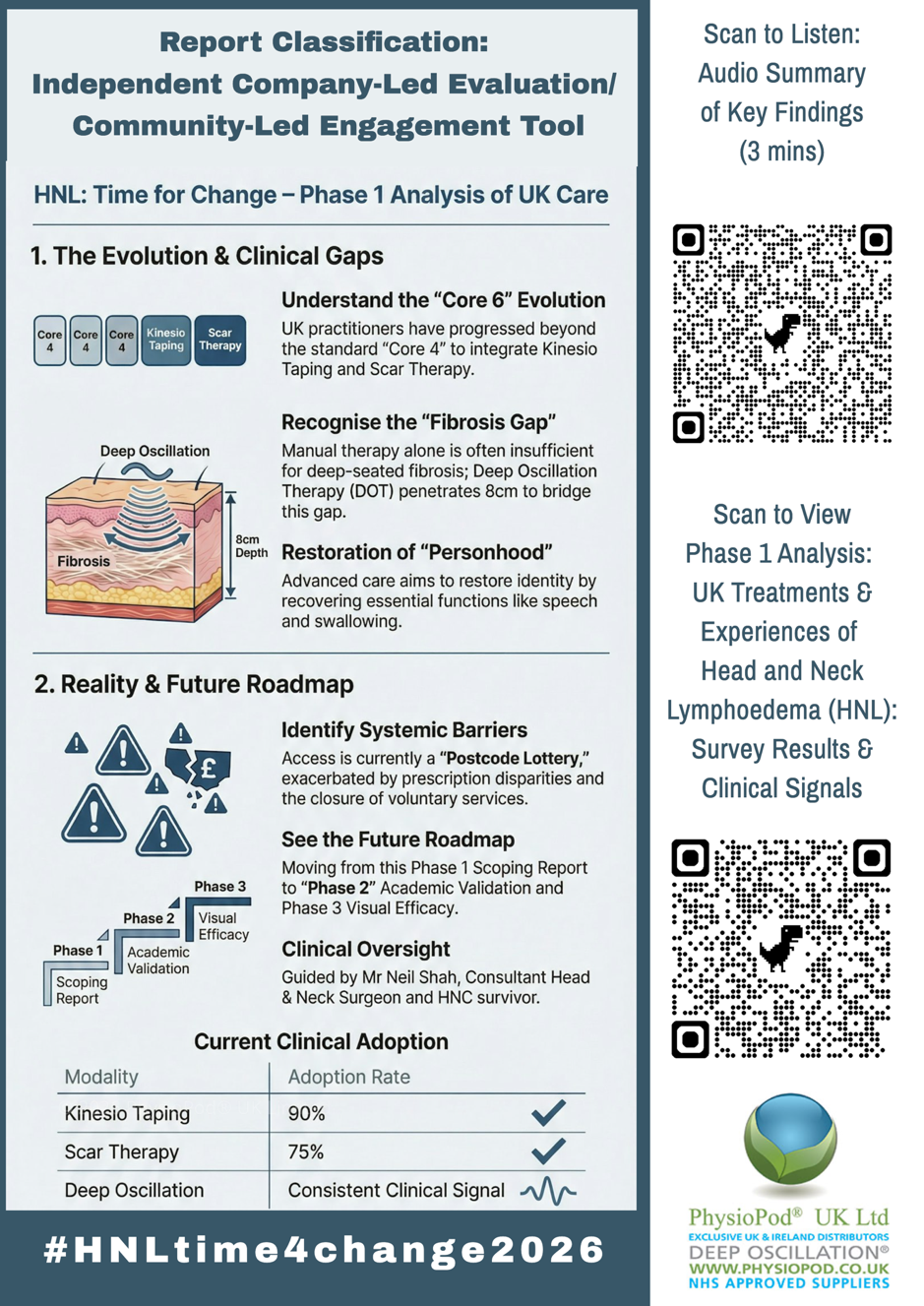
A central finding of the report is the recognition of a “Fibrosis Gap”. Clinicians reported that the dense, radiation-induced fibrosis characteristic of head and neck lymphoedema is often difficult to treat using standard Manual Lymphatic Drainage (MLD) alone.
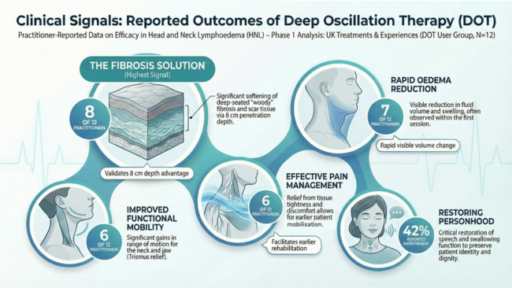
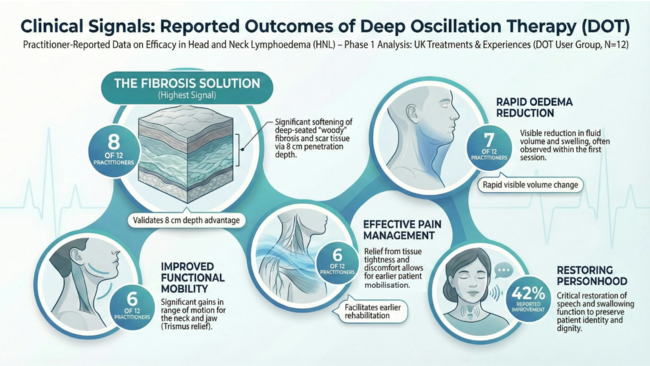
Within the DOT Group – practitioners and patients using Deep Oscillation Therapy – respondents reported consistent observations of “significant softening” of hardened tissue. These outcomes correspond with the therapy’s ability to penetrate tissues to a depth of up to 8 cm. The data indicates that this electrostatic approach may help overcome deep tissue resistance that manual techniques cannot access, potentially improving range of motion more quickly.
The report also highlights that reducing swelling in the head and neck region is not only a physical objective but also an important step in restoring identity. Patients reported that softening fibrosis through adjunctive treatments helped restore “Personhood”, enabling everyday social functions such as speaking, swallowing and smiling.
Despite advances in treatment methods, the evaluation also identified substantial inequality in service provision. Findings confirmed the existence of a “postcode lottery”, with many patients unable to access specialist services or obtain appropriate compression garments for head and neck lymphoedema through the NHS.
Consultant Head & Neck Surgeon Mr Neil Shah has described these findings as “strong signals” of unmet need that justify immediate action.
Following the evaluation’s findings, planning has begun for a formal Phase 2 research initiative. Led by Mr Shah, this next stage will use clinically validated assessment tools, including the Glasgow Benefit Inventory, to translate clinical observations into peer-reviewed evidence capable of informing healthcare policy and practice.
The full Phase 1 Analysis, including detailed data on the development of the “Core 6” treatment model and qualitative practitioner and patient feedback, is available for download via the PhysioPod® UK website.