
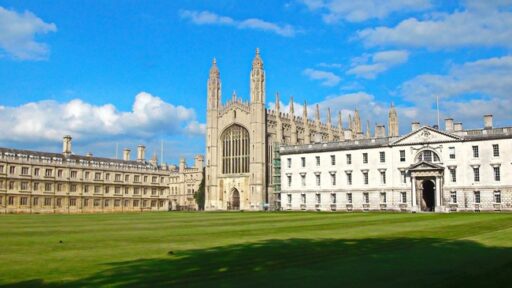

The University of Cambridge has retained its number one position in this year’s annual Complete University Guide rankings.
CAMBRIDGE, UK, June 2, 2026 – The University of Cambridge has once again been named the UK’s leading university in the latest Complete University Guide rankings. Oxford remains in second place, followed by the London School of Economics and Political Science, the University of St Andrews and Imperial College London, which moves up one position to fifth, completing this year’s top five institutions.
Within the top ten, the University of Warwick has risen two places to seventh, marking its strongest performance in more than a decade. The institution last achieved seventh place in the 2016 league tables.
Significant changes can also be seen elsewhere in the rankings. The University of Dundee records the largest improvement among institutions in the top 30, climbing 14 places to reach 25th position. Among the top 50 universities, Brunel University advances 19 places to 48th, while the University of Suffolk rises 11 places to 44th. The University of East London is the biggest mover overall, jumping 30 places in the national league table.
This year’s results suggest that access to highly ranked universities is becoming increasingly attainable for UK students. Of the universities ranked in the top 40, 29 have increased the proportion of UK undergraduates they admit. Among those institutions, 27 have also adopted more flexible entry requirements, reflecting evolving recruitment trends and creating additional opportunities for applicants.
Following a decline in last year’s figures, student continuation rates have improved. The proportion of students progressing from the first year of study to the second now stands at 91.1%, compared with 89.7% a year ago. The increase points to the positive impact of ongoing investment in student support services, although the figure remains below the 92.2% recorded in the 2025 rankings.
Across UK higher education, an average of 72% of graduates are either employed in graduate-level or professional roles, or continuing into postgraduate study, approximately 15 months after graduation. The rankings also highlight a number of universities that achieve exceptional graduate outcomes despite not appearing near the top of the overall league table. Institutions such as Harper Adams University, the University of Buckingham, St Mary’s University, Twickenham, Bournemouth University and Aston University demonstrate particularly strong employment results while welcoming students from a broad range of academic backgrounds.
Student demand remains strongest in several established subject areas. Business and Management Studies, Nursing and Midwifery, and Computer Science continue to attract the highest numbers of students, maintaining a trend that has remained largely unchanged over the past five to ten years. This year sees some modest movement elsewhere, with Law rising from fifth to fourth place and Psychology moving from fourth to fifth. Sociology and Drama, Dance and Cinematics each gain one position, reaching seventh and eighth respectively.

The University of St Andrews continues to hold the distinction of Scotland’s highest-ranked university, placing fourth nationally. Cardiff University remains Wales’ leading institution in 27th place overall, while Queen’s University Belfast is once again the highest-ranked university in Northern Ireland, occupying 23rd position.
The Complete University Guide publishes annual university and subject league tables to support prospective students as they make decisions about higher education. The rankings are particularly useful for those considering late applications or exploring options through Clearing.
Regional rankings are also available, helping students identify leading institutions closer to home. The publication of this year’s tables follows the Whatuni Student Choice Awards held last month, where students recognised universities across the UK for excellence in a variety of categories.
Professor Amanda Chetwynd, Chair of the Complete University Guide Advisory Board, said: “Congratulations to the University of Cambridge for once again securing first place in this year’s Complete University Guide rankings. Our methodology is based on a range of trusted and independent measures that reflect the issues students value most, including teaching quality, student satisfaction and graduate outcomes.
“This year’s rankings demonstrate that studying at a highly regarded university is becoming more achievable for a wider range of students. The changes we are seeing in entry requirements across the top 40 institutions represent a broadening of access, which is a positive development. Students who may previously have discounted certain universities should reconsider their options. The best university is not necessarily the one with the highest entry requirements. It is the one that best matches a student’s goals, aspirations and future plans.”
Simon Emmett, Chief Executive Officer, IDP UK, said: “One of the most encouraging findings in this year’s rankings is the wide range of opportunities available throughout the UK higher education sector. More universities in the top 40 are opening their doors to students from diverse backgrounds while continuing to deliver strong graduate outcomes, which is excellent news for prospective applicants.
“It is also positive to see improvements in student continuation rates. Universities have been investing in the support structures students need to thrive, and those efforts are now being reflected in the data. While there is still work to do, the overall trend is moving in the right direction.”