
Mobile operator integrates trade-in directly into its digital ecosystem, supporting growth across technology and gaming while minimising operational risk
EE, one of the UK’s leading mobile networks, has transformed its trade-in offering into a fully integrated marketplace capability, building it into the core purchase journey and establishing a scalable platform to support its expansion beyond mobile into wider tech and gaming categories.
The initiative responds to a clear market opportunity, as many households continue to store unused devices instead of releasing their residual value through trade-in. With consumers facing ongoing cost pressures and heightened sustainability awareness, EE identified demand for a streamlined process that links trade-in and new purchases within a single, trusted retail experience.
By redesigning its underlying infrastructure rather than introducing a separate bolt-on service, EE has delivered a smoother customer experience while gaining comprehensive oversight of trade-in volumes, valuations and commissions across its growing product range.
Instead of creating an entirely new system, EE’s digital product and architecture teams recognised that trade-in processes mirror those used in product returns, including device intake, logistics handling and value reconciliation.
In collaboration with marketplace platform provider Marketplacer, EE explored how its existing marketplace and returns workflows could be adapted for trade-in functionality. A proof of concept confirmed that the approach was viable, allowing the company to manage trade-in catalogues, device processing and settlements without complex, bespoke integrations.
“Once we realised trade-in could follow the same pattern as returns, everything clicked,” said Nagendra Kanakapura, Consumer Tribe Architect at EE. “It gave us a fast, low-risk path forward and allowed us to move with confidence.”
The strategy enabled rapid deployment while limiting technical risk. What began as a focused internal team expanded to more than ten squads working concurrently, allowing EE to launch the new capability across both its website and mobile app without compromising delivery oversight.
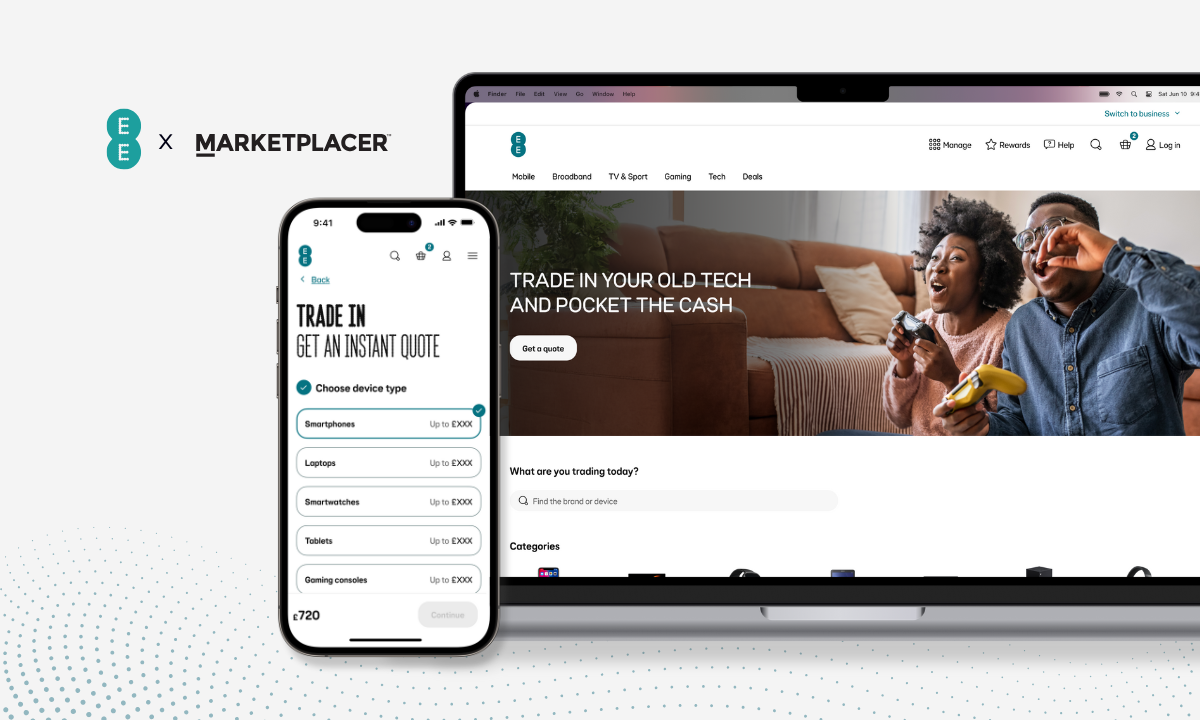
From launch, the trade-in service supported six device categories, providing a consistent digital journey. Customers can now obtain immediate trade-in valuations at checkout, with the quoted amount applied directly against their purchase, simplifying upgrade decisions.
“We saw trade-in as a way to make upgrading easier for customers, while supporting our expansion into new tech categories,” said Daniel Boulton, Digital Product Manager at EE.
“To do that, we needed a solution that could scale quickly and integrate directly into the customer journey.”
Operationally, the integrated model offers benefits that standalone trade-in providers often cannot match. EE now maintains full visibility over trade-in activity across categories, supporting more informed decisions around stock planning, pricing strategies and customer targeting.
The model also contributes to sustainability ambitions by promoting refurbishment and responsible recycling while unlocking value from dormant devices in UK households.
By positioning trade-in as a core marketplace function rather than an add-on service, EE has developed a model that can be replicated across channels and product categories. Future plans include expanding into additional device types and extending the capability into assisted retail settings to create a fully omnichannel experience.
The approach highlights how retailers can utilise existing technology infrastructure to introduce new services quickly and with reduced risk. Rather than waiting for entirely bespoke systems, EE’s team identified established operational patterns within its tech stack and repurposed them effectively.
For marketplace operators and platform providers, the case demonstrates the strategic advantage of adaptable architecture. Workflows originally designed for returns and third-party sellers have been redeployed to power a customer-facing trade-in solution, accelerating time to market while maintaining operational control.
With trade-in now fully embedded within its digital channels and purchase journey, EE has laid a strong foundation aligned with its broader ambitions across tech and gaming. The scalable framework ensures the company can adapt as customer expectations shift and new product categories emerge.
The integrated capability also strengthens opportunities for customer retention, as those choosing to trade in devices are already signalling upgrade intent and active engagement with EE’s expanding offering.
For further details, read the full EE trade-in case study.