

WOLVERHAMPTON, UK. July 20th, 2026 — jobsafe, the health, safety and environmental (HSSE) incident reporting platform built for UK trade and field service businesses, today called on road transport and warehousing operators to put jobsafe in every driver’s cab and on every warehouse floor.
The company argues that the single biggest factor in the cost of a safety investigation is not the incident itself, but the quality of the record left behind.
Transportation and storage remains one of the most closely watched sectors for both workplace and road safety enforcement in Great Britain. HSE’s latest figures show 15 workers were killed in the sector in 2025/26 — the fourth-highest total of any main industry grouping, behind only construction, agriculture and manufacturing — with vehicle movement, not machinery or falls, consistently the sector’s dominant cause of death: over a quarter of transport and storage worker fatalities in recent years have involved being struck by a moving vehicle, well above the all-industry share.
A further 40,000 workers in the sector self-reported a non-fatal injury in the most recent year, at a rate significantly above the all-industry average, and the sector’s workplace injuries now cost employers an estimated £1.4 billion annually.
Heavy goods vehicles made up only 10% of traffic on England’s motorways and major A-roads in 2024, yet were involved in 19% of collisions that killed or seriously injured someone — almost one in five.
National Highways recorded 1,151 crashes involving at least one HGV on the network that year, with rear-end shunts, most often a following vehicle striking the back of a lorry, accounting for 39% of all HGV-related collisions.
The agency has since launched joint crash-test research with Euro NCAP and European safety bodies to understand why these collisions keep recurring, while its long-running Operation Tramline programme, which places police officers in elevated, National Highways-funded HGV cabs, has recorded more than 57,000 driving offences since 2015.
On the yard and warehouse floor, HSE inspectors regularly describe workplace transport including vehicles reversing, loading and unloading and forklifts operating near pedestrians as one of the sector’s most persistent and preventable causes of serious harm, with reversing manoeuvres alone linked to close to a quarter of all workplace transport deaths.
In July 2025, a grocery wholesaler was fined £1 million after an employee was killed by a reversing HGV at one of its depots. HSE’s investigating inspector found the company had no safe system of work for its delivery and unloading activities.
Other recent prosecutions include a road haulage firm fined £250,000 after a worker died inside a shipping container, and a haulage operator fined £160,000 after a warehouse employee lost both legs when an unsecured pallet fell from a forklift truck. In each case, the investigation turned on the same question: what exactly happened, and when.
Wendy Dalton, CEO of jobsafe said: “Every one of these investigations comes down to the same gap — nobody can say with total confidence what happened, in what order, at what time. That’s not a training problem or a compliance problem, it’s a data problem. Whether it’s a driver on the M6 or a picker on a warehouse floor, if jobsafe is in their pocket, the record exists the moment the incident happens. That’s the difference between handing an inspector, or a claimant’s solicitor, a true account instead of a reconstruction.”
The app’s value lies as much in when the data is captured as in what it contains. “A GPS-tagged photo and timestamp logged in the same minute as a near miss on the yard, or a collision on the road, is a different category of evidence to a statement written up the next morning,” said Harrison Stanford, CTO of jobsafe.
“We built jobsafe so the record is contemporaneous by default, not by discipline. For an operator running vehicles and warehouses across multiple sites, that consistency — the same evidence standard whether the report comes from a cab or a loading bay — is what actually holds up.”
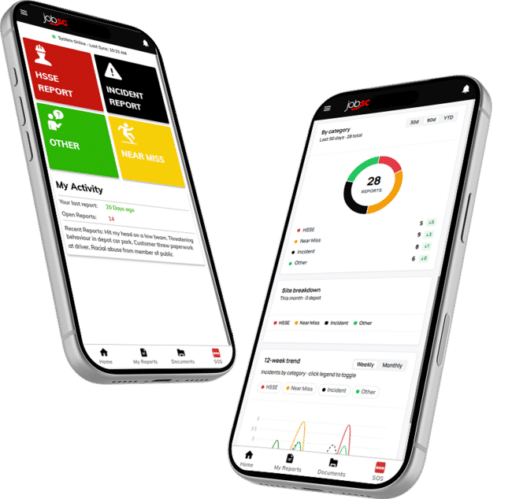
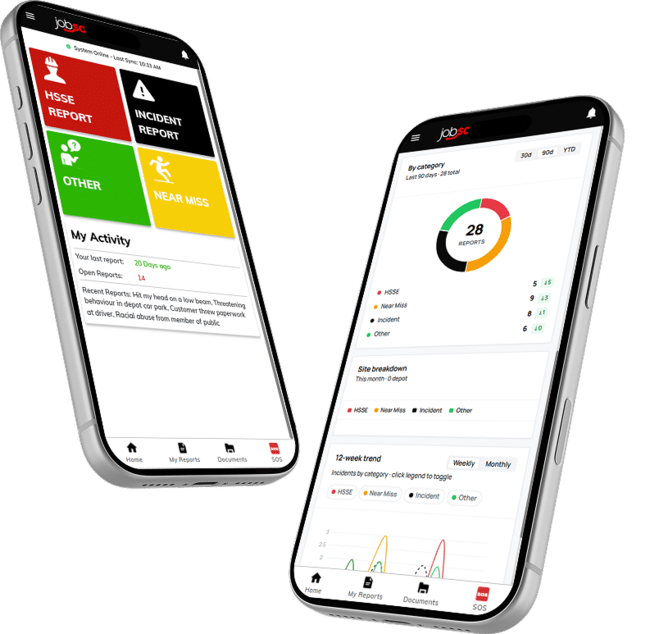
The moment an incident occurs, jobsafe captures time-stamped, GPS-tagged incident and near-miss reports, logged from any worker’s phone in under a minute. Photo and video evidence is attached at the point of occurrence rather than retrospectively.
The app also features a structured Record → Resolve → Prevent workflow which tracks every report through to close-out. Site and Depot-level dashboards give management real-time visibility across every location. This all adds up to a defensible, RIDDOR-ready audit trail which is available the moment HSE, an insurer or a solicitor asks for it.