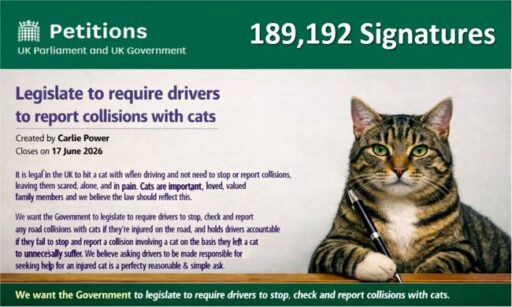

STOURBRIDGE, UK. October 8th, 2026 – A major public campaign is bringing the treatment of cats involved in road accidents back into focus, with CatsMatter urging Parliament to examine whether current reporting laws leave too many animals and owners without adequate protection. The appeal comes ahead of World Animal Road Accident Awareness Day on 10 October and the forthcoming debate on a petition that attracted 189,192 signatures.
Created by CatsMatter, World Animal Road Accident Awareness Day highlights the dangers animals face on roads and promotes measures to prevent avoidable injuries and deaths. It also provides an opportunity for animal welfare organisations to remember the domestic pets and wildlife affected by collisions every year.
The issue has particular significance for the UK’s cat-owning households. According to figures cited in a 2022 Early Day Motion, Petplan estimated that around 230,000 cats are hit by cars in Britain each year. Some survive but sustain injuries that require urgent veterinary care, while owners may struggle to find out what happened if a collision goes unreported.
On 26 October, MPs will debate e-petition 750612, which secured 189,192 signatures under the CatsMatter campaign. It is the largest cat welfare petition in parliamentary history. The debate will address whether the legal duty to report certain road collisions should be extended to cats, as well as the animals already covered by the law: horses, cattle, asses and mules, sheep, pigs, goats and dogs.
Mandy Hobbis, spokesperson for CatsMatter, said: “Every day, families receive the phone call they dread, or never receive one at all. For many owners, the hardest part is not knowing what happened to their cat or whether help could have arrived in time. The public increasingly sees cats as family members, and it is reasonable to ask whether current road traffic law reflects that reality. With compulsory cat microchipping now in place, Parliament has an opportunity to reconsider assumptions that may have made sense decades ago but deserve re-examination today.”
The legal framework is outlined in a recent House of Commons Library briefing, which refers to the Government’s longstanding explanation that the animals named in Section 170 of the Road Traffic Act 1988 were included because they were traditionally regarded as working animals, not domestic pets.
CatsMatter believes the role of cats in modern agriculture warrants further attention when that explanation is assessed.
A 2018 University of Bristol study found that 65% of sampled farms kept farm cats, with a median of two cats per farm. Even assuming a considerably lower prevalence of 30% across England, recent DEFRA farm statistics would indicate a population of approximately 60,000 working farm cats in England, kept primarily for rodent control.
By comparison, using DEFRA sheep farm data and reasonable assumptions regarding farm working dogs, CatsMatter estimates there may be approximately 65,000 working sheepdogs across England. While additional categories such as police, military and assistance dogs exist, these are relatively small in number compared with farm working dogs.
CatsMatter argues that the estimated scale of the working cat population should be considered when assessing why dogs are included in collision reporting legislation while cats are not. The organisation believes the comparison raises a legitimate question about whether the historic justification remains sufficient.
The campaign has also examined the argument that drivers may be unaware when they hit a cat. A 2023 Hungarian study into animal-vehicle collisions found that only 2.3% of pet collision cases involved uncertainty about whether a collision had occurred.
CatsMatter submitted its findings to the Department for Transport on 1 September 2026. The Department replied on 14 September, confirming that the issues were being considered in detail ahead of the debate.
Alongside its legislative campaign, CatsMatter welcomes work to improve how cats involved in road collisions are identified and reunited with their owners. Government-commissioned research is examining practical obstacles that can prevent pets from being returned to their families after an accident.
However, CatsMatter believes that improving identification is only part of the picture. The organisation says it has no visibility of an equivalent Government assessment of whether a legal duty to report collisions involving cats could improve access to treatment or increase the likelihood of owners being reunited with their pets.
The group is calling on Parliament to consider the potential practical benefits of such a change, including whether it could help more injured cats receive timely veterinary care, improve the flow of information to owners, or achieve both outcomes.
CatsMatter believes Parliament now has an opportunity to determine whether the law should better reflect the welfare needs of cats and the expectations of the public.
David Gibson, a volunteer strategist for CatsMatter, believes that improving the immediate response to animal emergencies is another important part of reducing suffering. He is working to establish the foundations of a concept often described as a “999 for animals”.
Gibson said: “Drivers should not be spending time frantically searching online at the roadside for someone who can assist whilst an animal is fading away. The public often has no clear understanding of who to contact, while responsibility is spread across a patchwork of charities, rescues, veterinary providers, councils and emergency services.”
He argues that the public currently faces a confusing landscape of organisations, with no single source providing consistent guidance about where to seek assistance. A coordinated gateway could help people identify the appropriate service more quickly, improve communication between providers and reduce preventable delays. The intention is to complement existing charities, veterinary services, councils and emergency responders, not to create a competing emergency service.
To advance the proposal, Gibson has incorporated Animal Emergency Service Ltd (AES), a mission-locked organisation established for public benefit. Its purpose is to strengthen coordination, information-sharing and signposting across the animal emergency sector, with an emphasis on independence and accountable governance.
AES expects to launch publicly through a crowdfunding campaign on 30 October, once the parliamentary debate has taken place. No Government funding is anticipated.
Hobbis concluded by emphasising the public’s desire for a stronger response to road collisions involving animals. She said “the UK public has made clear that they wish to see a modern legal duty for drivers to stop and assist if they are involved in a collision and it is safe to do so, a requirement already in place in jurisdictions such as Italy and Hong Kong.”