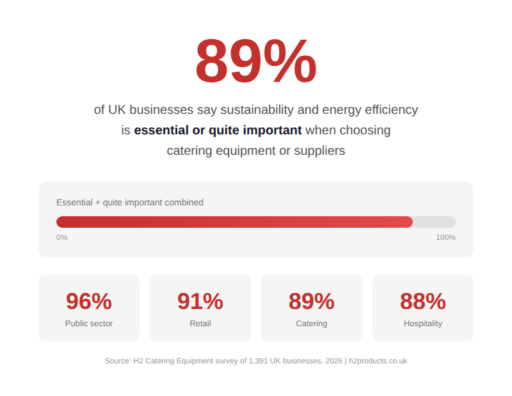
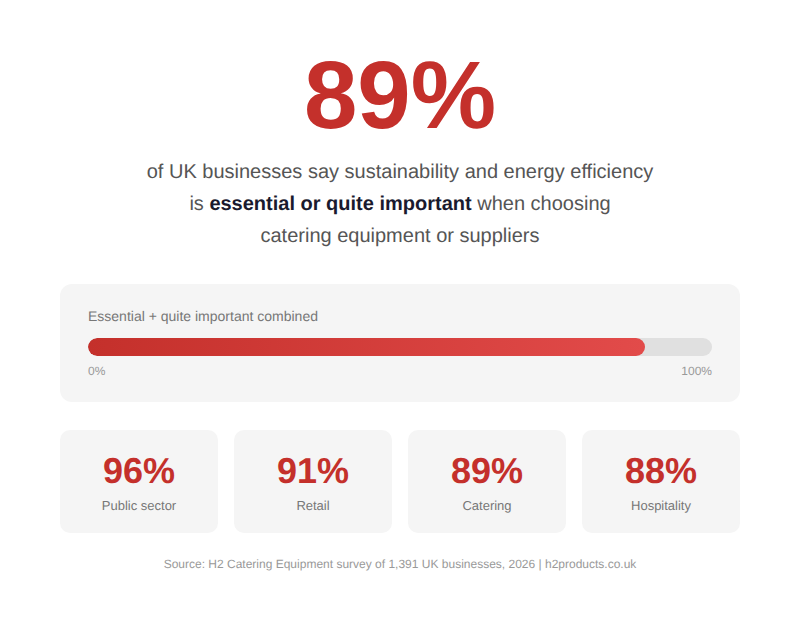

A comprehensive new survey covering 1,391 UK businesses across the hospitality, retail, catering, and public sectors has revealed that 89% of firms now regard sustainability and energy efficiency as either “essential” or “quite important” when procuring new catering equipment or selecting suppliers.
The results, drawn from senior decision-makers operating across four key industries, point to a fundamental shift in the way businesses approach the purchasing of equipment used throughout their kitchens, bars, and service areas.
Participants were asked one straightforward question: “When choosing new catering equipment or suppliers, how important are sustainability and energy efficiency?”
The public sector returned the highest figures of any group surveyed, with 96.4% of respondents classifying sustainability as essential or quite important. Not a single public sector respondent indicated that sustainability was of no importance whatsoever. This is consistent with the requirements set out in government procurement policy under PPN 06/21, which obliges suppliers tendering for significant public contracts to present credible and verifiable carbon reduction commitments.
Within the retail sector, 90.8% of respondents placed sustainability prominently within their procurement priorities, with 40.5% describing it as outright essential. The catering sector returned a figure of 88.7%, while hospitality, which provided the largest share of respondents at 574 businesses, recorded 88.0%.
At the opposite end of the spectrum, just 1.4% of all businesses surveyed indicated that sustainability plays no role at all in their purchasing decisions.
These findings come at a time when energy costs continue to weigh heavily on businesses across the sector. Data from the Carbon Trust indicates that hospitality businesses alone spend in excess of £1.3 billion on energy each year, producing upwards of eight million tonnes of carbon emissions in the process. The sector is estimated to consume as much as ten times more energy per square metre than the average commercial building.
Financial incentives introduced in recent months are also contributing to the momentum behind the shift towards more efficient equipment. From January 2026, unincorporated businesses and landlords became eligible for a new 40% first-year capital allowance on qualifying energy-efficient catering equipment, while incorporated firms continue to benefit from permanent full expensing that allows 100% write-offs in the first year. Together, these measures can reduce the effective cost of upgrading to more efficient equipment by as much as 25%.
Dale Howard, Director at H2 Catering Equipment said: “This data backs up what we’re hearing from customers every day. Businesses aren’t choosing energy-efficient catering equipment to tick a box. They’re doing it because their margins depend on it. When nine out of ten firms tell you sustainability is a priority, that’s not a trend. That’s just the way things work now.
“The results should be a wake-up call for catering equipment manufacturers, distributors, and suppliers across the UK. With nearly nine in ten businesses actively weighing sustainability in their procurement decisions, companies that cannot demonstrate verifiable energy efficiency credentials risk being left off shortlists altogether.”
Dale believes the survey results also highlight a significant and growing commercial opportunity within the public sector, where expanding requirements around Scope 2 and Scope 3 emissions reporting are leading procurement teams to seek carbon data from their suppliers at the level of individual products.
He added: “Manufacturers who can provide transparent energy ratings, lifecycle cost analyses, and embodied carbon data stand to win more of these contracts.
“The question buyers are asking has changed. It used to be ‘does it save energy?’ Now it’s ‘can you prove it?’ They want data, not promises. The businesses that do well from here will be the ones treating energy performance as a core product spec, not something they bolt on at the end.”