
LOUTH, UK. August 4th, 2026 – When the United Nations Secretary-General said that no child should become ‘a guinea pig for unregulated AI’, British author Simon H King felt the conversation about children and artificial intelligence (AI) had reached a turning point.
For years, much of the public debate around AI had centred on employment, productivity, regulation and what the technology might one day be capable of. Now, the effect it could have on childhood was being discussed at the highest international level.
Simon believes one part of that conversation still belongs much closer to home.
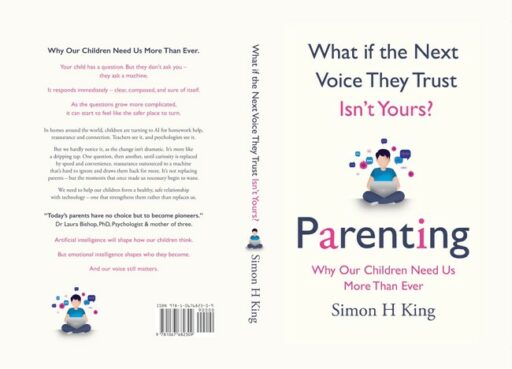
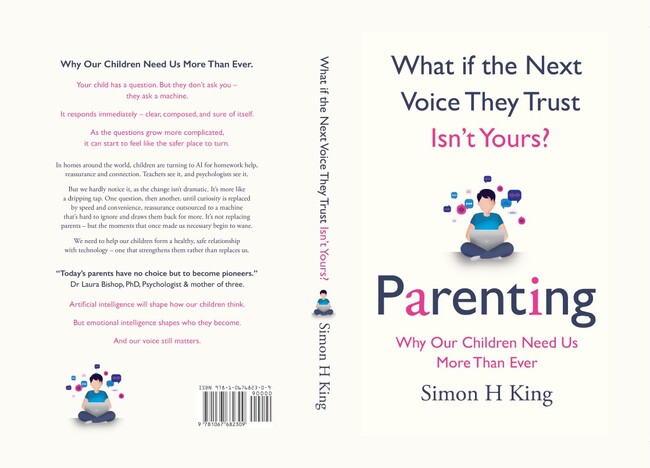
His new book, What if the Next Voice They Trust Isn’t Yours?, asks what happens when children begin turning to artificial intelligence not only for facts or help with homework, but for advice, reassurance and companionship.
‘The UN’s intervention is an inflection point,’ Simon said. ‘It confirmed that protecting children in the age of AI is no longer a concern for some distant future. It is something governments, technology companies, schools and parents need to think about now.
‘But safety is only part of the question. We also need to ask what place AI may come to occupy in a child’s life, and what happens when a machine that is always available becomes one of the voices they trust most.’
Simon didn’t write the book to argue that children should be kept away from artificial intelligence. He believes they will need to understand it, question it and learn how to use it well.
Nor does he suggest that parents must suddenly become technology experts. ‘I am a parent writing to other parents,’ he said. ‘Most of us are already juggling work, family life and everything else that comes with raising children. We won’t know everything about AI, and our children may understand the technology more quickly than we do.
‘What we can do is remain curious. We can sit alongside them, ask where an answer came from and help them understand that something sounding confident does not automatically make it true, wise or right for them.’
The book considers the effect AI could have on curiosity, emotional availability, creativity, misinformation, deception, independent thought and a child’s developing sense of self.
It also explores a tension Simon believes many families will recognise: AI can make life easier, but convenience mustn’t take the place of connection.
‘Unlike us parents, AI doesn’t get tired or say, “Can we talk about this later?”‘ Simon said. ‘It can respond immediately and appear endlessly patient. That can be enormously useful, but it may also make it a persuasive presence in a child’s life.
‘We can’t compete with a machine by trying to be faster. What parents can offer is a real relationship, lived experience and love. Our children don’t need us to be perfect. They need us to remain present and part of the conversation.’
The foreword has been written by Dr Laura Bishop, a psychologist specialising in human-technology interaction and mother of three teenage children.
Dr Bishop describes the book as having arrived ‘at exactly the right time’ and writes that today’s parents ‘have no choice but to become pioneers’. She argues that AI should exist within the walls of family values, rather than replacing them.
For Simon, that pioneering role doesn’t mean families must navigate the future alone.
‘We are all learning,’ he said. ‘That’s why parents need to talk to one another and why this conversation cannot belong solely to scientists, engineers or policymakers. There is an important conversation to be had around the kitchen table too.’
What if the Next Voice They Trust Isn’t Yours? is available in paperback, hardback and ebook formats.