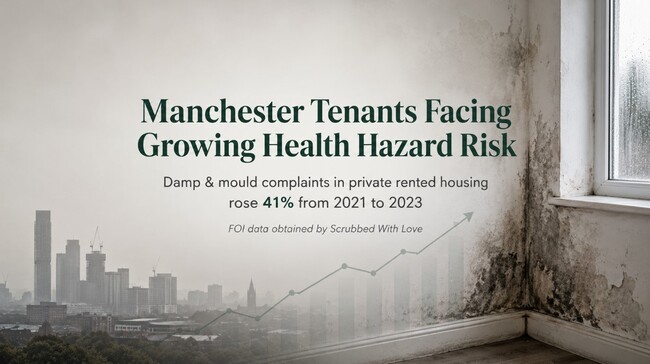

MANCHESTER, UK. June 30th, 2026 – Freedom of Information data obtained by Scrubbed With Love has revealed a dramatic rise in damp and mould complaints linked to private rented housing in Manchester, with figures climbing from 649 reports in 2021 to a peak of 918 in 2023 – a 41% increase in two years.
The data, which covers the period from 2021 to 2025, also shows that housing enforcement complaints have remained persistently high across the same period, with the council receiving more than 1,600 housing requests for service every single year.
The figures, obtained directly from Manchester City Council under the Freedom of Information Act, paint a concerning picture of conditions facing renters in the city.
Damp and mould complaints relating to private rented properties rose steadily from 649 in 2021 to a peak of 918 in 2023 before falling slightly to 897 in 2024 and 759 in 2025. Even at their most recent level, reports remain significantly higher than they were at the start of the five-year period.
The pattern mirrors national concern over housing standards in the private rented sector following the death of two-year-old Awaab Ishak in Rochdale in 2020, which led to a coroner’s ruling that prolonged exposure to mould in his family’s housing association property directly caused his death. The case triggered widespread scrutiny of damp and mould conditions across both social and private rented housing.
Despite awareness growing significantly in the years following Awaab’s Law, complaint volumes remained elevated through 2024 and have not returned to 2021 levels.
Alongside damp and mould, the FOI data reveals that general private rented housing enforcement complaints have stayed consistently high, with little sign of meaningful improvement over the five-year window.
In 2021, there were 1,665 housing requests for service. This fell to 1,602 in 2022 before rising sharply to 1,755 in 2023.
The 2023 figure of 1,755 represents the highest point in the dataset. While the number has reduced slightly since then, to 1,694 in 2024 and 1,627 in 2025, the overall picture is one of sustained demand on the council’s housing enforcement capacity rather than a declining problem.
Josie Cookson, owner of Scrubbed With Love said: “For tenants living in substandard conditions, the practical consequence is often a lengthy wait for council intervention. Where enforcement is delayed or disputes are prolonged, the underlying conditions – damp, mould growth, structural deterioration – can worsen significantly before professional remediation takes place.”
The FOI request also captured data on discarded needle and sharps reports received by Manchester City Council’s street cleansing teams.
In 2021, there were 304 reports of discarded needles and sharps. This fell to 199 in 2022 but has since remained consistent with 198 reports in 2023, 193 in 2024 and 182 in 2025.
The figures reveal that the issue remains a persistent feature of the city’s public environment, even as reported incidents have fallen from their 2021 peak.
Across the full five-year period, the council received at least 1,076 reports of discarded sharps requiring street cleansing intervention.
Josie Cookson added: “The decline in reported incidents since 2021 may reflect changes in service demand, reporting behaviour or operational priorities rather than a straightforward reduction in the problem on the ground. Discarded needles present a significant contamination risk in communal areas, car parks, alleyways and open spaces, and require specialist handling and disposal to protect public safety.”
One of the most significant issues the data raises is not only the volume of complaints, but what happens in the period between a report being made and the problem being resolved.
Josie Cookson said: “For damp and mould, that gap can span weeks or months. During that time, mould colonies can spread across walls, ceilings and soft furnishings, releasing spores that aggravate respiratory conditions, trigger allergic reactions and in vulnerable individuals pose a serious health risk. Standard cleaning products and DIY approaches are often ineffective against established mould growth, and in more severe cases, specialist biohazard-grade remediation is required.”
For landlords, the consequences of delayed action can be severe under the Homes (Fitness for Human Habitation) Act 2018 and, increasingly, under the provisions being introduced through Awaab’s Law.
Scrubbed With Love works with landlords, letting agents, housing associations and private tenants to carry out safe and thorough remediation of damp, mould, contaminated waste and sharps incidents across the Greater Manchester and Liverpool area.
Josie Cookson added: “What these figures confirm is something we see on the ground every week.
“Tenants are living with mould that has been there for months, sometimes longer. By the time we’re called in, it has gone well beyond what a landlord can deal with themselves. The council is doing what it can with the resources it has, but there is a real gap between a complaint being lodged and conditions actually improving. That is the gap we exist to fill.”